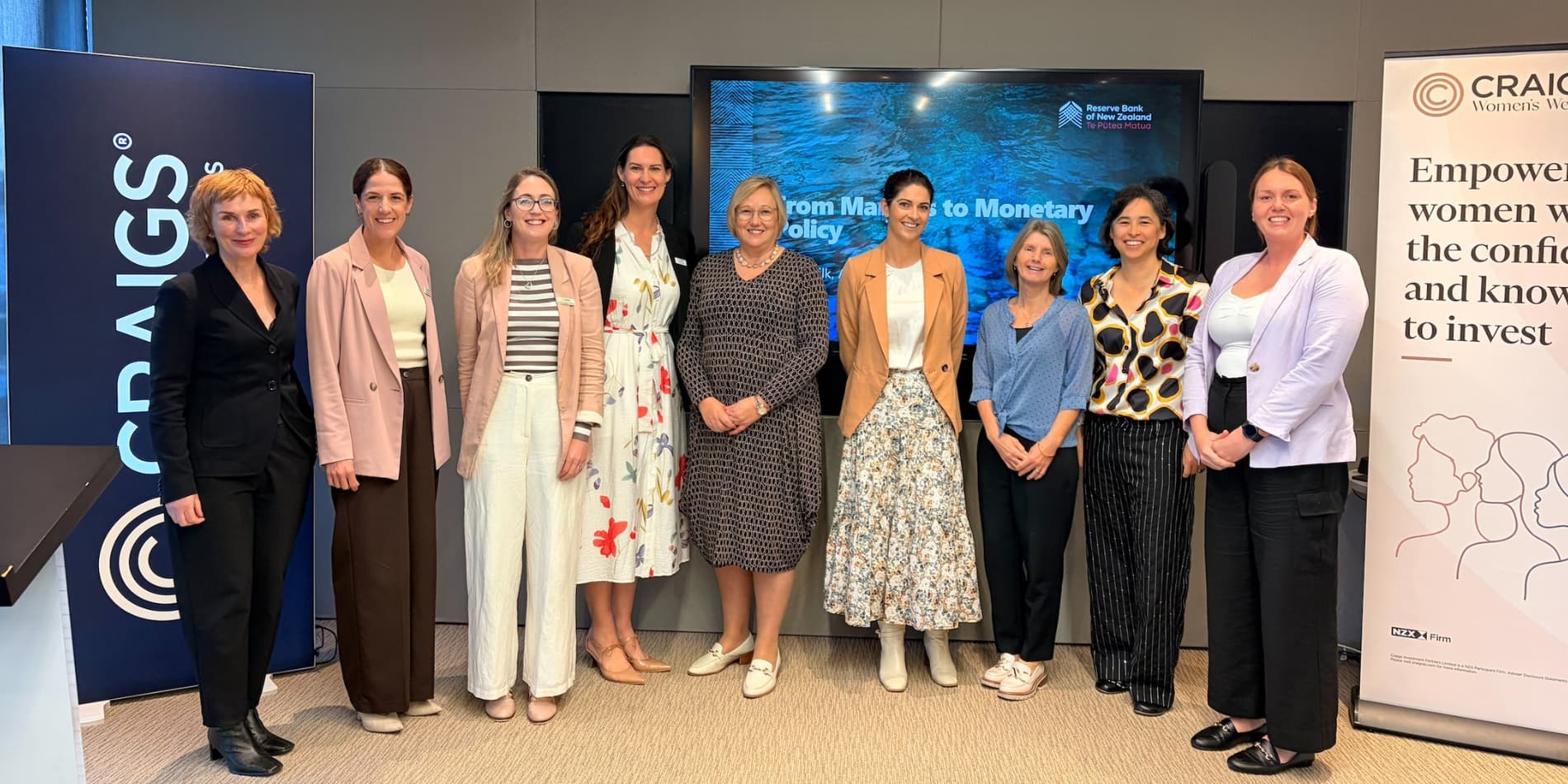
We recently hosted Karen Silk, Assistant Governor at the Reserve Bank of New Zealand, at one of our Craigs Women’s Wealth breakfast events in Tauranga. Karen spoke about her journey through more than 30 years in financial services and shared insights on what has shaped her career and her advice for women navigating their own.
A career shaped by saying yes
One of the themes that stood out was Karen’s willingness to embrace opportunities that sat well outside her comfort zone. Ironically, banking was the one career she was certain she did not want when she left university. Yet a chance decision to join Westpac’s graduate programme ultimately led to her joining the Reserve Bank in 2022 as Assistant Governor.
What made Karen’s story so interesting wasn’t her impressive CV – it was how she got there. From our conversation with Karen, it was clear that her career has been defined by a willingness to step into unfamiliar territory, back herself in challenging environments, and seek out opportunities rather than waiting for them to come to her. From institutional banking to agribusiness, leadership roles in Australia and ultimately the Reserve Bank, the thread running through her career has been a readiness to put her hand up and say yes – even when the path ahead wasn’t entirely clear.
Three principles that have underpinned her success
Reflecting on what has driven her career, Karen identified three things she believes have been central to her success – and they are worth thinking about regardless of where you are in your own journey.
Be open to new and challenging roles. Karen has consistently sought out roles that stretched her, even when they took her well outside her comfort zone. Her decision to leave institutional banking – a field she’d spent 15 years building a successful career in – to set up Westpac New Zealand’s agribusiness division is a good example. She had no farming background, but saw an opportunity to broaden her leadership experience in a way that wasn’t available to her in institutional banking at the time. This decision in turn opened the door to bigger opportunities down the track. Growth doesn’t come from doing what you already know – it comes from backing yourself to figure it out.
Have the courage to hold to your values. A career spanning more than three decades will inevitably bring moments of real challenge – difficult conversations, tough environments, pressure to compromise. Karen spoke about the importance of standing firm in those moments and not losing sight of what matters to you. Being prepared to take a public voice on critical issues and then following through with real action has created some of her greatest opportunities for impact. Courage, she said, isn’t the absence of difficulty, it’s how you respond to it.
Focus on using your experience to have a positive impact. Karen was clear that purpose and fulfilment are closely linked. Her work has been most meaningful when she’s been able to apply her experience to create something of genuine value – whether that’s building a new business, shaping sustainable finance policy, or contributing to monetary policy decisions that affect the entire economy. Impact doesn’t have to be grand. It can be as simple as helping someone else develop or shifting the way a team thinks about a problem.
Mentors, sponsors, and putting your hand up
She also drew a useful distinction between mentors and sponsors. A mentor offers guidance, while a sponsor actively takes steps to advance your career. Karen credited both throughout her journey, however, observed that men (particularly younger men) tend to be more comfortable asking for sponsorship. She encouraged women to become more comfortable seeking sponsorship and putting themselves forward for opportunities, observing that many talented individuals can be reluctant to do so.
Technology is no substitute for judgement
The conversation also touched on artificial intelligence and the opportunities it presents. Karen sees AI as a powerful productivity tool, both within the Reserve Bank and across the wider economy. However, she also highlighted an important challenge: when technology does more of the analytical heavy lifting, younger professionals must still find ways to develop the judgement and experience that comes from working through complex problems themselves. As she put it, technology can enhance our capabilities, but it cannot replace the value of critical thinking, curiosity, and sound judgement.
Compounding your career
It was great to have Karen join us. As investors, we frequently talk about the power of long-term compounding. Karen’s career is a reminder that the same principle often applies to professional development – small decisions to learn, adapt, and take on new challenges can compound into opportunities that are difficult to imagine at the outset. Her advice – consistently do your best work, put your hand up for new challenges, and don’t wait to be invited. Careers are rarely linear, and many of the opportunities that shaped Karen’s path were not part of a carefully designed plan – they came because she was willing to step forward.
–
Photo L-R: Bridget Cummins, Annemarie Hills, Katie Douglas-Clifford, Julia Foxley, Karen Silk, Jaimee Thomsen, Janice Allan, Michelle Perkins and Belinda Wilson.
Market Insights enewsletter
Keep up to date with our fortnightly Market Insights enewsletter. Our research team provide timely and regular commentary and analysis on market developments, understanding investment jargon, and the impact of current events.


Michelle Perkins
Director, Wealth Research
Market Insights enewsletter
Keep up to date with our fortnightly Market Insights enewsletter. Our research team provide timely and regular commentary and analysis on market developments, understanding investment jargon, and the impact of current events.